
Posted in Books, communication, happiness, life

Growing Up in the Age of Anxiety: A Gen X Mom’s Reflection on The Anxious Generation by Jonathan Haidt

As a Gen X mom raising two Gen Z kids – a bright, sensitive daughter and a thoughtful, tech-savvy son – I’ve watched their childhoods unfold in ways I never could’ve imagined. When I was their age, my biggest thrill was riding bikes until the streetlights came on. Today, their world lives in the palm of their hands.

Jonathan Haidt’s The Anxious Generation hit me like a ton of bricks – not just as a book, but as a mirror. It gave words to what I’ve been sensing for years: that something fundamentally changed around 2010, when smartphones and social media became the air our kids breathe. Here’s what I learned and how I’m trying to help my kids navigate it all.

📱The Rise of the “Phone-Based Childhood” (Post-2010)

Key Shifts:

  • Unsupervised Screen Time Replaced Real-World Play
    • Kids stopped hanging out in person and started hanging out online.
    • Less face-to-face interaction stunted development of social-emotional skills.
  • Social Media Became the New Playground (and Battlefield)
    • Especially for girls, platforms like Instagram and TikTok became spaces of constant comparison, judgment, and anxiety.
    • The “like” button turned self-worth into a public scoreboard.
  • Boys Turned to Gaming and YouTube
    • Boys retreated into gaming worlds, often isolating themselves from real-life friendships and emotional expression.
    • While not as appearance-focused as girls’ online experiences, this led to emotional numbness and social disconnection.
  • Sleep, Focus, and Mental Health Declined Sharply
    • Screen use before bed ruined sleep hygiene.
    • Constant pings and dopamine loops reduced attention spans and increased anxiety and depression.

💔 How It Hit Home for Me

I’ve seen my daughter’s self-esteem crash after scrolling Instagram, comparing herself to perfectly filtered influencers. I’ve watched my son lose hours to YouTube rabbit holes and video games, sometimes struggling to express how he feels or deal with real-world stress.

They are not lazy. They are not weak. They are navigating a world that’s radically different – and, in many ways, untested.

🛑 What We Can Do to Reclaim Childhood

Jonathan Haidt doesn’t just diagnose the problem – he offers a path forward. Here’s what we should start doing (and what I wish we’d all consider as a community):

1. Delay the Smartphone

  • Wait until at least age 14 to give a smartphone with full internet access.
  • Start with a basic phone for safety (calls/texts only).

2. No Phones in Bedrooms at Night

  • Made charging stations in the kitchen, not the bedrooms.
  • Better sleep = better mental health.

3. Encourage In-Person Friendships

  • Set up regular playdates, hangouts, or outdoor time.
  • Support extracurriculars that build social bonds – sports, drama, volunteering.

4. Model Digital Discipline

  • I’ve started putting my own phone down during dinner or family time.
  • Kids learn more from what we do than what we say.

5. Push for School-Wide Phone Bans

  • Haidt recommends schools become phone-free zones.
  • When my daughter’s school limited phones, bullying incidents and distractions dropped.

6. Teach Tech Literacy and Emotional Resilience

  • Talk to kids openly about algorithmic traps, online peer pressure, and curated realities.
  • Normalize therapy, mindfulness, and mental health check-ins.

🧭 Looking Ahead: Raising Resilient Kids

As a Gen X parent, I straddle two worlds: the analog one I grew up in and the digital one my kids are drowning in. The Anxious Generation reminded me that while technology has changed, the core needs of children haven’t – love, connection, purpose, and play.

We owe it to our kids to give them more than dopamine hits and screen time. Let’s give them a childhood worth remembering.


📘 Highly Recommend:
Jonathan Haidt’s The Anxious Generation is a must-read for any parent, educator, or policymaker. It’s not just about fear – it’s about hope, backed by research, compassion, and common sense.
Posted in Books, Data Analysis, life, Quotes, TED talks

Hans Rosling: How much do you know about the world?

I can’t believe that just recently I was introduced and had the chance to watch Hans Rosling’s Ted talk of how much misconception there is in the world about the current poverty rates and the rate of world’s population growth. The talk was recorded in 2014, so some 6 years ago and I don’t think there is much of difference in people’s understanding about the world.

Hans Rosling, unfortunately no longer among us, was a professor of global health at Sweden’s Karolinska Institute and his work was focused on eliminating the myths about the developed and developing world, the poverty state and the overall state of the world.

He is using remarkable visual representation to interpret the statistical data and show a worldview, which is not as dramatic as we wish to think and the world is in much better state than we wish to admit.

In his book Factfulness, Hans Rosling, together with his two long-time collaborators Ola and Anna, provides an explanation of why most people share the misconceptions and what causes the distortion of our perspective.

When things are getting better we often don’t hear about them. This gives us a systematically too-negative impression of the world around us, which is very stressful.”

― Hans Rosling, Factfulness: Ten Reasons We’re Wrong About the World—and Why Things Are Better Than You Think

Book cover of Factfulness : ten reasons we're wrong about the world--and why things are better than you think

Every group of people I ask thinks the world is more frightening, more violent, and more hopeless—in short, more dramatic—than it really is.

― Hans Rosling, Factfulness: Ten Reasons We’re Wrong About the World—and Why Things Are Better Than You Think

Posted in Inspirational, life, Motivation, Quotes

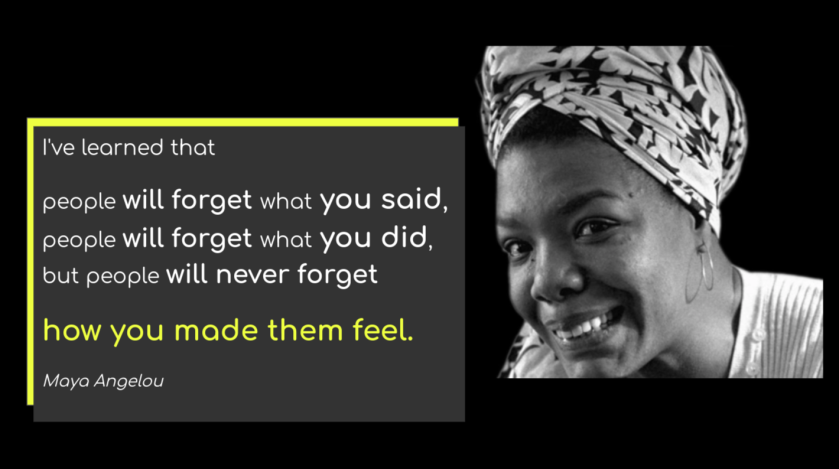
Maya Angelou: “I’ve learned that people will forget what you said …” – Inspirational Quote

Of course, we don’t want to make other people feel miserable or unhappy. So, how do we make them feel good and improve their spirit?

Here are 10 ways to make other people feel special:

  1. Start with smiling – Being positive with others makes them relaxed and opened for collaboration.
  2. Compliment on their appearance – Noticing their shiny healthy hair or being fit and in good shape will do amazing things for their motivation to continue take good care of them selves.
  3. Show appreciation – Frequently express how much you enjoy your interactions and how much your collaborations were beneficial to you.
  4. Support their ambitions – Help them maintain Growth mindset, learn from mistakes and continue dreaming & growing.
  5. Give them undivided attention – Listen wholeheartedly and show empathy and support.
  6. Give them public recognition – Post on social media, or give kudos during team meetings or family gatherings. Showing appreciation in public is a great way to display how much you value the other person.
  7. Share your tips and tricks – Sharing your secret resources make other people feel very special and if they listen to you as a mentor, it is another way to motivate them to reach higher levels of their potential.
  8. Show vulnerability – Share mistakes and silly thing you have made in the past, and how you recovered and learned from them. This will encourage them to share and be vulnerable as well and realize they are not alone in how they are feeling.
  9. Take part in their project – Offer support and help with a big project they are working on before they start feeling overwhelmed.
  10. Offer to do something special – just the two of you: go for a walk, coffee or spend time outside of the daily routine schedule and focus on other things that matter outside of work or study.

When we help to make people feel special, we make better connections, foster kindness, motivate and inspire growth. Who did You Help today?

Posted in Inspirational, life, Quotes

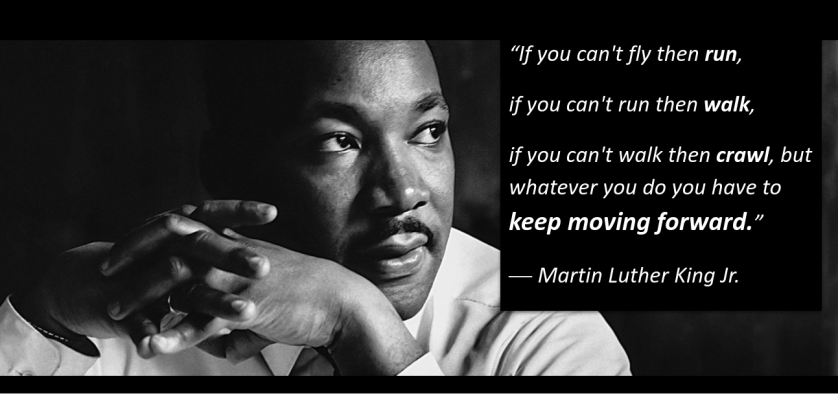
Martin Luther King Jr.: “You have to keep moving forward.” – Inspirational Quote of the Week

Happy Wednesday!

What does it mean to you to keep moving forward? Here are some points on what it means to me and practices and trying to implement:

  • Stay positive, find positive – make the best of a bad situation. Researchers say that up to 80% of our thoughts are negative. You should learn to recognize your negative thoughts and switch to positivity, which will make you feel better about yourself and your life. Imagine having 80 percent positive thoughts!
  • Don’t quit early – you need to try one thing enough times to make it work and learn how to perfect it. If you give up too early you might never build resilience to cope with difficult situations.
  • Keep learning –  whether it’s in the office or in personal life, you stumble upon random things you don’t know but can make your life and work better. Take the time to learn more about them and start using and implementing new techniques.
  • It’s not a race, and you should move at your own speed. Complete one task at a time and then move to the next one. Multitasking is creating stress and overwhelming – it feels like you have a mountain of work on your shoulders, you don’t know where to start and lose a perspective of which task is more important and the priorities overall.
  • Learn to deal with the disappointment – recognize that what you are going through now is not permanent. Take the time to refocus and gain clarity, and prepare for the next challenge.


“Life is like riding a bicycle. To keep your balance you must keep moving.” ~ Albert Einstein

Hope you are keeing your balance and moving forward every day!

Posted in Books, Inspirational, life, success

A Great Summer Read – “Thirst” by Scott Harrison

Thirst is a remarkable representation of empathy, compassion and true giving. the author of the book Scott Harrison founded The charity: water back in 2006 with no funds and no experience. Through the years, his organization has raised over $300 million to bring clean drinking water to more than 8.2 million people around the globe.

Well written, the book is a memoir of the author’s life and a story of The charity: water – his vision of changing the world for the better, the purpose and the WHY of his life. Thirst is full of interesting and compassionate stories about the communities suffering from lack of water and the tireless unique & creative ways of the charity to collect funds, build trust in donors and deliver sustainable water solutions for the millions of families in need.

Everyone should read this book – there is so much that can inspire you to go out and change the world by as little as donating your birthday to a higher cause than just acquiring stuff.

Happy reading!

Posted in happiness, Inspirational, life, Quotes

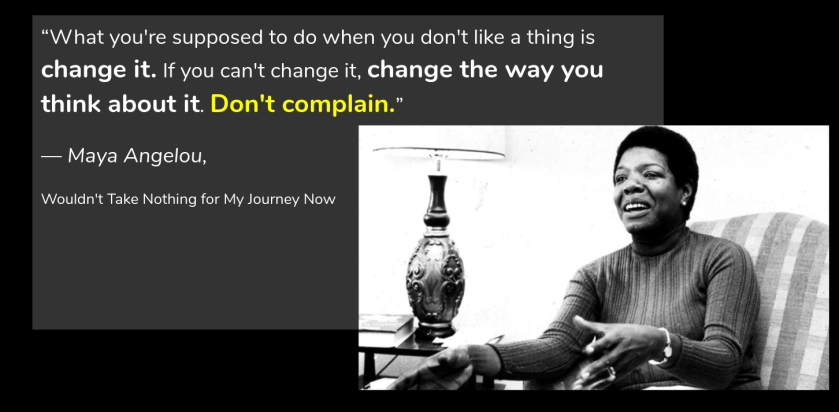
Maya Angelou: “Don’t Complain.” – Inspirational Quote of the Week

Happy Wednesday!

Today’s quote is really powerful, but you have to be ready to change and be emotionally mature to be able to make it work for you. 

What should you do when you are not happy with the reality? You should cultivate a “can-do” attitude and start changing the life around you one-step-at-a-time, piece by piece until you build a happier place for you and people surrounding you.

If things are out of your hands, and it’s hard to alter the reality around, you should try to change your way of thinking and make the most of the situation, keep positive and find the things that makes you happy.

Here are 10 tips to complain less and stop the negative thoughts so you can focus on finding solutions and be happier:

  1. Shift your thinking from negative to positive thoughts
  2. Be less judgmental to you and the others
  3. Make a list of things you’re grateful for
  4. Be the change you wish to see in the world
  5. Accept responsibility
  6. Keep moving forward and take care of yourself
  7. Find what makes you happy.
  8. Practice yoga
  9. Allow yourself to vent every once in a while
  10. Be more mindful and assertive

Posted in communication, life, Personality, success, TED talks

The 4 Practices to Cultivate Wholeheartedness?

When you ask people about love, they’ll tell you about heartbreak. When you ask people about belonging, they’ll tell you about how they have been excluded. When you ask people about connection, the stories they’ll tell you are about disconnection.

Interesting, right? We always first recall the negative experiences in life and mute the positive memories.

Dr. Brené Brown is a research professor at the University of Houston and the author of five #1 New York Times bestsellers: The Gifts of Imperfection, Daring Greatly, Rising Strong, Braving the Wilderness, and Dare to Lead.

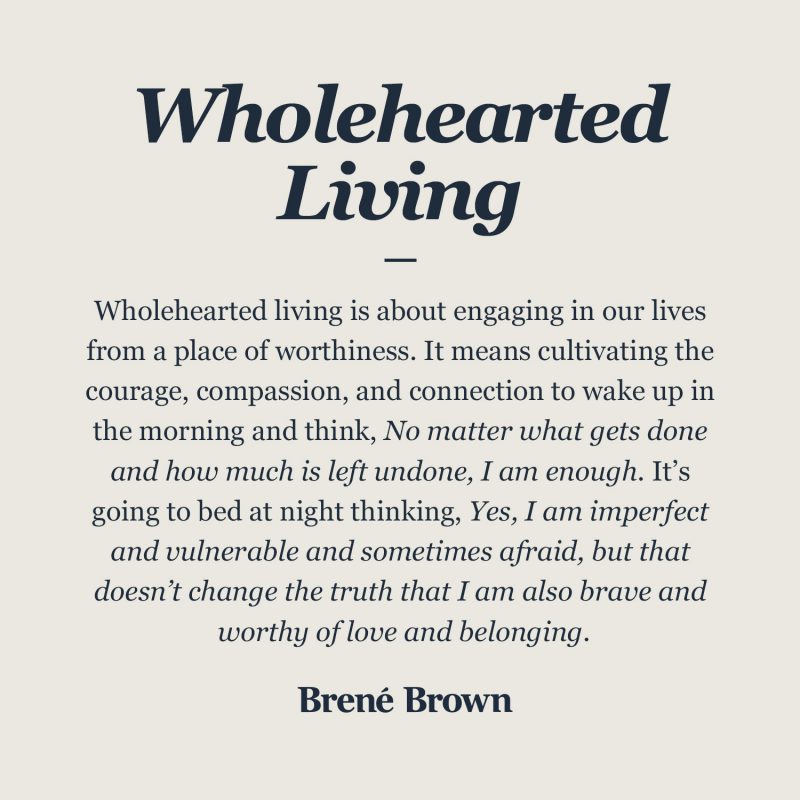
In her TED Talk: The power of vulnerability, she outlines the following four life-changing practices that can help us live worthy, wholehearted life, stop recalling only the heartbreak, pain and disconnection, but find the joy and happiness: 

  1. Have a sense of COURAGE – when communicating with others tell the story of who you really are and accept your imperfections.
  2. Practice COMPASSION – treat yourself kindly first and then treat others with compassion.
  3. Develop CONNECTION as a result of authenticity – willingness to let go of who you think you should be in order to be who you are.
  4. Embrace VULNERABILITY – give without expecting anything in return, share anything without the fear of being judged, open yourself to people you love, because you are worthy of the same love. If we don’t allow to be vulnerable, we block the joy, gratitude and happiness, and feel worse.
wholehearted-living-definition-800x800-1

If you want to learn more how to live with courage an vulnerability, check out Dr. Brown’s book

Daring Greatly: How the Courage to Be Vulnerable Transforms the Way We Live, Love, Parent, and Lead

Posted in happiness, Inspirational, life, Quotes

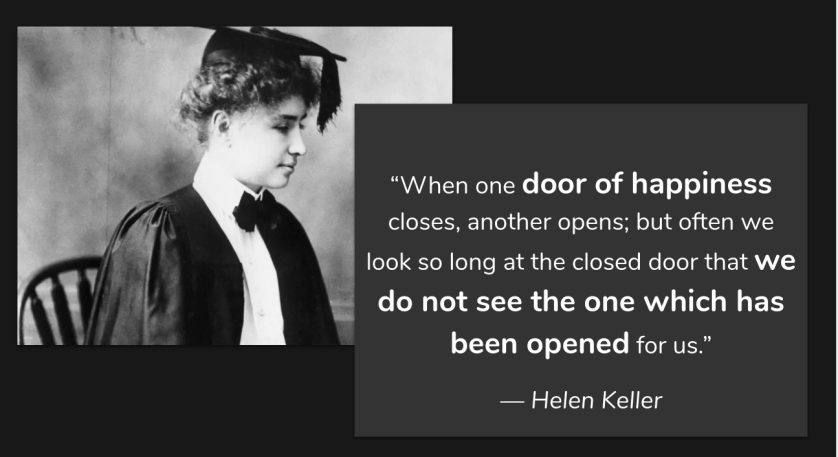
Helen Keller: “When one door of happiness closes” – Inspirational Quote of the Week

Happy Tuesday!

I hope all of you were able to have a relaxing and happy long weekend despite the overwhelming and controversial pandemic news everywhere.

This week’s quote comes from Helen Keller – an American author, political activist, and lecturer, who was the first deaf-blind person to earn a Bachelor of Arts degree.

This quote is almost 100-years old and still 100% valid.

When we have experienced happiness, we try to cherish and think of it, like it will never happen again and tend not to jump right into a new experience. Most of us are cautious when starting a new task or event and assess the success of it through the lens of already experienced success. It’s the same with happiness – we don’t see the new opportunity of being happy again, as we are comparing the new experience with the previous, and they will never be the same.

More happiness quotes from Helen Keller:

“We are never really happy until we try to brighten the lives of others.”

“I take happiness very seriously. It is a creed, a philosophy, and an objective.”

“If we do not like our work, and do not try to get happiness out of it, we are a menace to our profession as well as to ourselves.”

Posted in Inspirational, life, Quotes

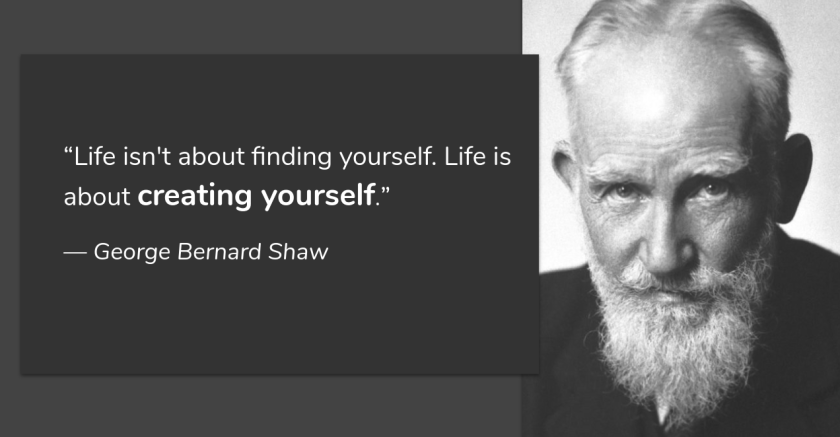
George Bernard Shaw: “Life isn’t about finding yourself.” – Inspirational Quote of the Week

Happy Tuesday!

Today’s timeless quote comes from the great Irish playwriter George Bernard Shaw written in his satiric work “An Unsocial Socialist”, published at the end of XIX century.

Isn’t it an interesting point of view?

I don’t know about you, but I grew up thinking: What is my purpose in this life? What is the reason for my being? What are my talents? and When will I find myself?

And the truth is, very few people know their talents from a young age. And even if they know their talent, lots of hard work and learning is needed to master a talent i.e. to create yourself.

For the rest of us, where the talent is not defined early, we need to:

  • learn new things on a regular basis;
  • repeat what we know to master a skill,
  • connect our knowledge and build on top of it.

This is basically the process of creating ourselves. Once we start sharing our knowledge, helping others, getting a sense of accomplishment, and even feeling happy with our contribution, then we can say we created ourselves. But that’s not the end of it – lifelong learning continues and self-development never stops.

Thanks and stay safe!

Posted in Books, happiness, life

The 3 Rules For Unforgretable Experience

Actress Marilu Henner is 1 of 10 known people in the world with the ability of superior autobiographical memory – an astonishing ability to recall details of every day of her life. In her book “Total Memory Makeover”, Marilu unfolds pros and cons of having autobiographical memory and illustrates them with multiple personal stories.

Part of the book is dedicated to help the readers improve their memories, enjoy and cherish every moment of the life, by keeping a memory journal to track events from the past and build personal history “track”.

What I like the most from her advice in the book is the three simple rules for unforgettable experience, which I admit is 100% true for my memories of events from my past that have left vivid imprints in my mind.

The first rule is: ANTICIPATION – Make sure to get prepared for the event. Talk to family and friends about it, reveal your plans, and show excitment. For example, if you are planning a two-week vacation, allocate time to get mentally ready, to plan fun trips and entertainment and share the plans with someone.

The second rule is PARTICIPATION – once you arrive at the event or start the trip, try to be 100% present, participate in the planned activities and have fun – enjoy the moment to the fullest, take photos, mementos and keepsakes. Don’t forget to keep a journal with notes from the journey – it will come handy later when you need to refresh the memories.

Total Memory Makeover: Uncover Your Past, Take Charge of Your Future

The third rule is RECOLLECTION, and comes after the event or activity is completed, and you are no longer part of it. This phase is the longest and can continue forever, but should start as soon as the experience is over, while the memories are still fresh. Start talking to friends and family – how photos from the places you’ve been, share stories what happened and how it felt.

Please make sure to check out the book for more entertaining, and educational advices from Marilu. The book is easy to read and her stories for sure will resonate with readers everywhere.